
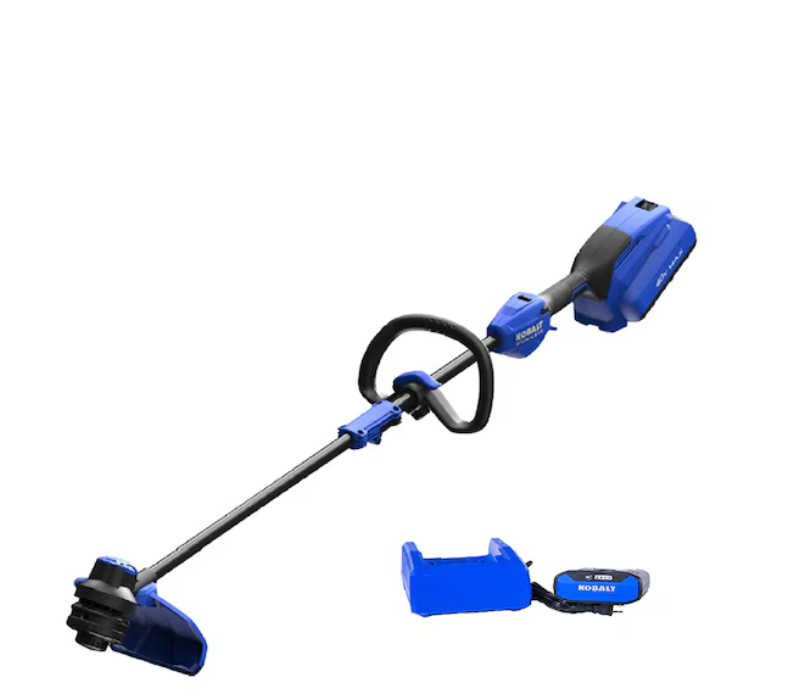
Kobalt Gen4 40-volt 15-in Straight Shaft Battery String Trimmer 4.0 Ah (Battery Included) (Charger Included)
- Brushless motor offers increased power, longer run time and prolonged motor life
- 15-in cut swath and 2 speeds to complete the job quickly
- Dual side bump feed provides effortless line advancement
- Quick-reload head for quick and easy line replacement
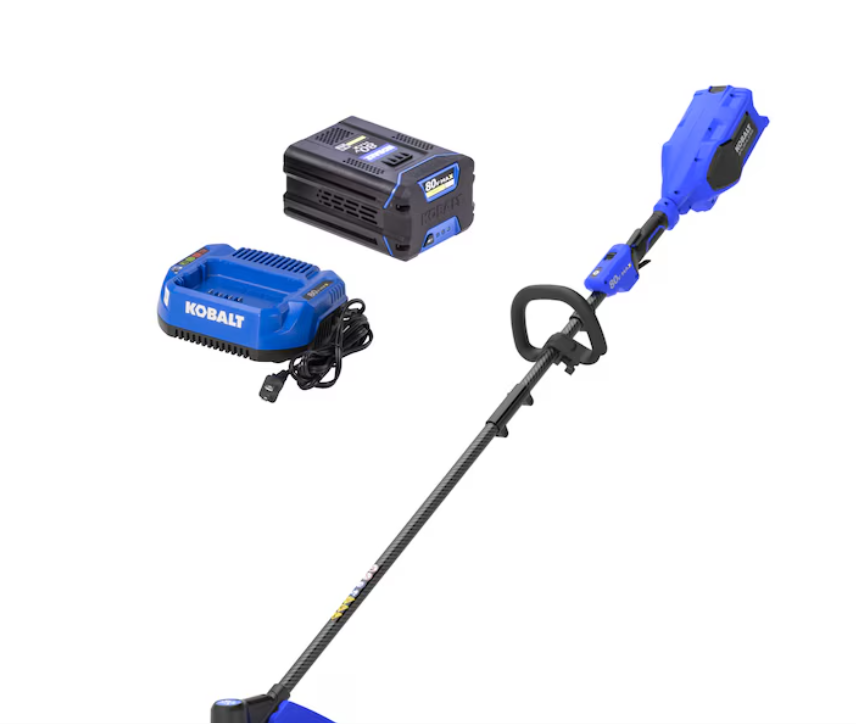
Kobalt Carbon Fiber 80-volt 17-in Straight Shaft Battery String Trimmer 2 Ah (Battery Included) (Charger Included)
- 17-in cutting path
- Up to 50 minutes of runtime on a single charge of the included 2.0Ah battery
- Power brushless motor provides more torque, quieter operation, and longer runtimes
- 2.0Ah battery fully charges in just 60-minutes
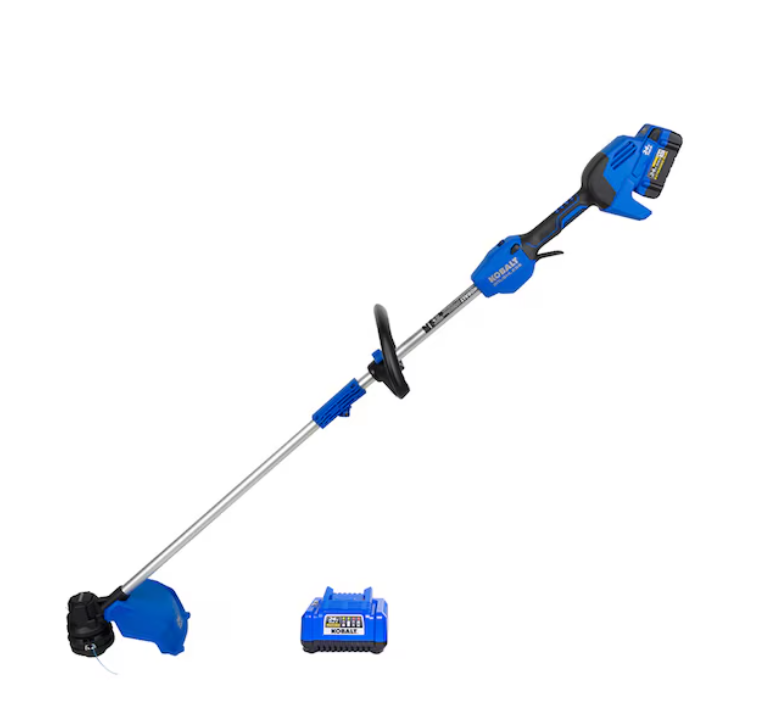
Kobalt 24-volt 14-in Straight Shaft Battery String Trimmer 4.0 Ah (Battery Included) (Charger Included)
- Lightest weight string trimmer in it’s class
- Dual line bump feed provides effortless line advancement
- 12-14-in cut swath to complete the job quickly
- 5 year limited warranty
From Novice to Pro: Mastering Your Yard with Kobalt’s Revolutionary String Trimming Technology
When the morning dew settles on your lawn and you’re armed with a Kobalt weed eater, there’s something almost meditative about transforming an overgrown landscape into a masterpiece of precision. The satisfying whir of the motor, the clean lines left behind, and that sense of accomplishment when you step back to admire your handiwork – this is what makes the Kobalt weed eater more than just another power tool in your garage.
But let’s be honest: choosing the right string trimmer can feel like navigating a maze of technical specifications, competing brands, and marketing promises. That’s where this comprehensive guide comes in. We’re going to dive deep into the world of Kobalt weed eaters, exploring everything from their cutting-edge battery technology to the nitty-gritty details of string replacement and maintenance.
Understanding the Kobalt Brand Revolution
Before we delve into the specifics of what makes the Kobalt weed eater a standout choice for homeowners, it’s worth understanding the philosophy behind the brand. Kobalt has positioned itself as the thinking person’s power tool manufacturer – offering professional-grade performance at prices that won’t require you to take out a second mortgage.
The company’s approach to weed eaters reflects this ethos perfectly. Rather than overwhelming consumers with dozens of confusing models, Kobalt has streamlined their offerings to focus on what really matters: reliable performance, user-friendly design, and value that extends far beyond the initial purchase price.
What is the Best Kobalt Weed Eater for Home Use?
The crown jewel of Kobalt’s string trimmer lineup is undoubtedly the Kobalt 80V Max Brushless Cordless String Trimmer. This isn’t just marketing hyperbole – it’s a tool that genuinely transforms how you approach yard maintenance. With its brushless motor technology, this Kobalt weed eater delivers consistent power that rivals gas-powered alternatives while maintaining the convenience and environmental benefits of battery operation.
What sets this model apart is its intelligent design features. The automatic feed system means you’re not constantly stopping to manually advance the string, and the variable speed trigger gives you precise control whether you’re delicately trimming around flower beds or attacking stubborn weeds along fence lines. The ergonomic design reduces fatigue during extended use sessions, making it ideal for homeowners who take pride in maintaining their entire property themselves.
For those with smaller properties or lighter trimming needs, the Kobalt 40V Max Cordless String Trimmer offers excellent value without sacrificing performance. It’s particularly well-suited for suburban lots where precision and maneuverability matter more than raw cutting power. The lighter weight makes it an excellent choice for users who might be intimidated by heavier gas-powered alternatives.
The Art and Science of Using Your Kobalt Weed Eater
Operating a Kobalt weed eater effectively is part technique, part understanding your tool’s capabilities. The first principle is proper stance and movement. Unlike a lawnmower that you push in straight lines, a string trimmer requires a sweeping motion that follows the natural contours of your landscape.
Start by familiarizing yourself with the controls. The variable speed trigger on most Kobalt weed eater models allows you to match power to the task at hand. Light weeds around decorative elements call for gentle, controlled passes, while thick grass along driveways might require full throttle. The key is developing a feel for how different vegetation responds to varying speeds and angles.
Safety considerations go beyond just wearing eye protection, though that’s certainly crucial. Understanding the cutting radius of your Kobalt weed eater helps prevent damage to desirable plants and reduces the risk of debris flying toward people or property. Always maintain awareness of your surroundings, particularly when working near vehicles, windows, or outdoor furniture.
The technique for achieving professional-looking results involves overlapping your passes slightly and maintaining a consistent height above the ground. Most experienced users find that keeping the string head about an inch above the soil surface provides the best balance between effective cutting and preventing accidental gouging of the lawn.
Battery-Powered Excellence: The Kobalt Advantage
One of the most significant decisions facing modern homeowners is choosing between gas-powered and battery-powered outdoor equipment. Kobalt weed eaters have firmly embraced the battery revolution, and for good reason. The instant-start convenience eliminates the frustration of pull-cord starting, especially on humid mornings when gas engines can be particularly stubborn.
The environmental benefits extend beyond just eliminating exhaust emissions. Battery-powered Kobalt weed eaters operate significantly quieter than their gas counterparts, making early morning or evening yard work more neighborly. This noise reduction also makes the tools more pleasant to use for extended periods, reducing user fatigue and allowing for better awareness of your surroundings.
Kobalt’s battery technology deserves special recognition. Their lithium-ion batteries maintain consistent power output throughout the charge cycle, meaning your Kobalt weed eater cuts just as effectively when the battery indicator shows 20% as it does at full charge. This consistent performance is crucial for achieving uniform results across your entire property.
Investment Considerations: Kobalt Weed Eater Pricing
When evaluating the cost of a Kobalt weed eater, it’s essential to think beyond the initial purchase price. While entry-level models start around $99 for basic 40V units, the premium 80V systems can reach $300 or more when purchased with batteries and chargers. However, this investment perspective changes dramatically when you consider the total cost of ownership.
Gas-powered alternatives might have lower upfront costs, but they require ongoing investments in fuel, oil, spark plugs, and air filters. Over a typical five-year ownership period, these operational costs can easily exceed $200, not counting the time and frustration associated with seasonal maintenance and repairs.
Kobalt weed eater models also retain their value better than many competitors. The build quality and brand reputation mean that a well-maintained unit can command reasonable resale prices if you decide to upgrade or no longer need the tool. This residual value is particularly important for homeowners who view their tools as investments rather than consumables.
Purchasing Your Kobalt Weed Eater: Navigation and Strategy
The primary retail channel for Kobalt weed eaters is Lowe’s Home Improvement stores, where the brand maintains an exclusive relationship. This exclusivity actually works in the consumer’s favor, as it means better inventory availability and more knowledgeable staff support compared to brands that are scattered across multiple retailers.
Lowe’s frequently runs seasonal promotions on Kobalt power tools, particularly during spring preparation periods and end-of-season clearance events. Smart shoppers can often find significant savings by timing their purchases to coincide with these promotional periods. Additionally, the store’s price-matching policies can provide leverage when competing retailers offer lower prices on comparable battery-powered string trimmers.
Online ordering through Lowe’s website offers the convenience of home delivery or in-store pickup, which can be particularly valuable when purchasing complete kits that include multiple batteries and accessories. The website also provides detailed product comparisons and customer reviews that can inform your decision-making process.
For rural areas where Lowe’s stores might be less accessible, the company’s professional sales team can often arrange special ordering and delivery options. This service is particularly valuable for customers purchasing multiple tools who want to ensure battery compatibility across their entire Kobalt ecosystem.
Mastering String Replacement: The Essential Skill
String replacement is the most fundamental maintenance skill for any Kobalt weed eater owner, yet it’s also the source of the greatest frustration for newcomers. Understanding your specific model’s string loading system is crucial, as Kobalt uses different mechanisms across their product line.
The bump-feed system, common on most Kobalt weed eater models, requires understanding the relationship between the string length, tension, and the automatic advancement mechanism. When reloading, ensure that you’re using the correct string diameter – typically 0.080 inches for most residential models. Using incorrect string thickness can cause feeding problems and reduce cutting effectiveness.
The key to successful string installation lies in maintaining proper tension and avoiding tangles within the spool. When winding new string, keep consistent tension and ensure that the wraps don’t overlap or cross each other. Most Kobalt weed eater spools have directional arrows that indicate the proper winding direction – following these markings prevents feeding issues and ensures smooth operation.
Pre-cut string segments are often easier to work with than continuous spools for novice users. These segments eliminate guesswork about proper length and reduce the likelihood of creating tangles during installation. While they cost slightly more per linear foot, the convenience and reliability often justify the additional expense, particularly for homeowners who use their Kobalt weed eater infrequently.
Warranty Protection and Customer Support
The warranty coverage on Kobalt weed eaters reflects the company’s confidence in their manufacturing quality. Most models include a five-year limited warranty that covers defects in materials and workmanship, which is notably longer than many competitors offer on comparable products.
Understanding what the warranty covers – and what it doesn’t – can influence both your purchasing decision and how you maintain your Kobalt weed eater. Normal wear items like strings, spools, and guards are typically excluded, as is damage resulting from improper use or lack of maintenance. However, motor failures, battery defects, and manufacturing flaws are covered, providing significant peace of mind for your investment.
Kobalt’s customer service reputation deserves mention because warranty coverage is only as good as the company’s willingness to honor it. The brand has generally received positive feedback for responsive customer service and reasonable interpretation of warranty terms. Having your purchase receipt and product registration can expedite warranty claims if issues arise.
The warranty also extends to batteries, which is particularly important given their role as the most expensive consumable component in the system. Battery warranty terms typically cover capacity degradation beyond normal parameters and complete failure, though they exclude damage from misuse or environmental extremes.
Battery Life and Performance Optimization
The runtime of your Kobalt weed eater depends on numerous factors beyond just battery capacity. Understanding these variables allows you to maximize efficiency and plan your yard work sessions more effectively. String condition plays a surprisingly significant role – dull or damaged string requires more power to cut effectively, reducing overall runtime.
Cutting techniques also impact battery consumption. Smooth, controlled movements require less power than aggressive, choppy motions. Learning to let the string do the work, rather than forcing the Kobalt weed eater through resistant vegetation, can extend runtime significantly while also producing better results.
Temperature affects battery performance in ways that many users don’t anticipate. Extreme heat can reduce capacity and potentially damage cells, while very cold conditions temporarily reduce available power. Storing batteries in climate-controlled environments and allowing them to reach moderate temperatures before use helps maintain optimal performance.
Kobalt’s fast-charging technology deserves recognition for its practical benefits. The ability to achieve 80% charge in 30-45 minutes means that battery depletion doesn’t necessarily end your yard work session. Having a spare battery eliminates downtime entirely, allowing you to maintain momentum when tackling larger properties.
Kobalt vs. Ryobi: A Detailed Comparison
The comparison between Kobalt weed eaters and Ryobi models represents one of the most common decision points for homeowners entering the battery-powered tool ecosystem. Both brands offer compelling value propositions, but they target slightly different user priorities and preferences.
Ryobi’s strength lies in their extensive tool ecosystem and accessory compatibility. Their ONE+ battery platform spans an enormous range of tools, from household items like vacuums to professional-grade construction equipment. If you’re planning to build a comprehensive collection of battery-powered tools, Ryobi’s breadth of offerings is difficult to match.
However, Kobalt weed eaters often edge out Ryobi in pure performance metrics. The brushless motor technology and optimized power delivery systems typically provide superior cutting power and efficiency. This performance advantage is most noticeable in demanding applications like thick grass or woody weeds where sustained power output matters most.
Build quality represents another differentiating factor. Kobalt weed eaters generally feature more robust construction with better weather sealing and more durable components. This translates to longer service life and reduced maintenance requirements, particularly important for users who store their equipment in unheated garages or sheds.
The pricing comparison reveals interesting dynamics. While individual Kobalt weed eater units might cost slightly more than equivalent Ryobi models, the total system cost often favors Kobalt when you factor in battery performance and longevity. Ryobi’s lower entry costs can be misleading if you need multiple batteries or frequent replacements.
Maintenance Strategies for Longevity
Proper maintenance of your Kobalt weed eater extends far beyond occasional string replacement. Developing a systematic approach to care ensures reliable performance and maximizes your investment’s lifespan. The maintenance schedule should align with usage patterns – weekly during peak growing season, monthly during moderate use periods.
Cleaning represents the most fundamental maintenance task, yet it’s often overlooked or performed inadequately. Grass clippings, sap, and debris accumulation can interfere with moving parts and ventilation systems. Using compressed air or a soft brush to remove buildup from the motor housing, string head, and battery connection points prevents premature wear and overheating issues.
Battery maintenance deserves special attention because replacement costs represent a significant portion of the tool’s original purchase price. Avoiding complete discharge cycles and storing batteries at moderate charge levels (40-60%) during extended periods of non-use helps maintain cell integrity. Temperature extremes during storage can permanently reduce capacity, making climate-controlled storage worthwhile for premium battery systems.
The string cutting head requires periodic disassembly for thorough cleaning and inspection. Worn or damaged components in the feed mechanism can cause string jams and inconsistent advancement. Replacement parts for Kobalt weed eaters are generally available and reasonably priced, making preventive replacement more cost-effective than waiting for complete failure.
Expanding Capabilities with Compatible Attachments
The versatility of Kobalt weed eater systems extends significantly through compatible attachments that transform your string trimmer into a multi-purpose tool. Edger attachments convert your Kobalt weed eater into a precise sidewalk and driveway edging tool, creating clean lines that would otherwise require a separate dedicated tool.
Brush cutter attachments unlock the ability to tackle woody growth and thick vegetation that would overwhelm standard string cutting heads. These attachments typically feature metal blades or heavy-duty cutting discs that can handle saplings, thick weeds, and overgrown areas that haven’t been maintained regularly.
Pole saw attachments extend your Kobalt weed eater’s reach for pruning tasks that would otherwise require ladders or professional services. While not suitable for heavy tree work, these attachments excel at maintaining fruit trees, removing low-hanging branches, and managing vegetation along property lines.
The key to successful attachment use lies in understanding the power limitations of your specific Kobalt weed eater model. While the motor might physically accept various attachments, optimal performance requires matching attachment demands to available power output. Overloading the system with excessive attachment weight or cutting resistance can damage the motor and void warranty coverage.
Precision Edging Techniques and Applications
Using your Kobalt weed eater for edging requires different techniques and considerations compared to general trimming applications. The vertical orientation and precise control necessary for effective edging demand practice and patience to master, but the results justify the learning investment.
Proper edging technique begins with understanding the relationship between string contact angle and cutting effectiveness. The string should contact the material being cut at approximately 90 degrees for optimal efficiency. Shallow angles tend to push material rather than cutting cleanly, while steep angles can cause excessive string wear and inconsistent results.
The speed control becomes crucial during edging operations. Unlike general trimming where full throttle often produces the best results, edging typically requires moderate speeds that allow for precise control and consistent depth. The goal is creating clean, uniform lines rather than maximum material removal.
Kobalt weed eater models with adjustable handles and heads provide significant advantages for edging applications. The ability to optimize the tool’s orientation for your height and the specific task reduces fatigue and improves result quality. Some users find that marking their desired cutting depth with tape on the guard helps maintain consistency across long edging runs.
Power Comparisons and Performance Benchmarks
When evaluating the power output of Kobalt weed eaters relative to other brands, it’s important to understand that marketing specifications don’t always translate directly to real-world performance. Voltage ratings, while useful for general comparisons, don’t account for motor efficiency, battery discharge characteristics, or mechanical design optimization.
In practical cutting tests, Kobalt weed eaters consistently perform at or above their specifications, particularly when dealing with dense vegetation and extended use sessions. The brushless motor technology contributes significantly to this performance advantage by eliminating the friction and power losses associated with traditional brushed motors.
The power delivery characteristics of Kobalt weed eaters tend to favor sustained performance over peak output. While some competitors might achieve higher instantaneous power ratings, Kobalt’s systems maintain more consistent performance throughout the battery charge cycle. This characteristic is particularly valuable for users who tackle large areas or demanding vegetation types.
Torque output, often overlooked in marketing materials, significantly impacts cutting effectiveness in challenging conditions. Kobalt weed eaters generally provide superior torque characteristics compared to similarly priced competitors, translating to better performance when the string encounters resistance from thick stems or matted vegetation.
Large Yard Capabilities and Limitations
The suitability of Kobalt weed eaters for large yard applications depends largely on your definition of “large” and the specific characteristics of your property. For suburban lots up to an acre, most Kobalt weed eater models provide excellent performance with proper battery management and technique optimization.
Battery capacity becomes the primary limiting factor for extensive properties. The highest-capacity Kobalt weed eater batteries typically provide 45-60 minutes of moderate-use runtime, which translates to trimming coverage of approximately 0.5-0.75 acres depending on vegetation density and cutting requirements. Multiple batteries or strategic work session planning becomes necessary for larger areas.
The weight advantage of Kobalt weed eaters compared to gas-powered alternatives becomes more significant during extended use sessions typical of large yard maintenance. Reduced fatigue allows for longer productive work periods and better result quality throughout the session. However, this advantage diminishes if you need to carry multiple batteries to complete the job.
Professional landscapers and property managers with extensive trimming requirements might find Kobalt weed eaters suitable for detailed work and areas where noise restrictions apply, but they typically supplement them with gas-powered equipment for high-volume cutting. The key is matching tool capabilities to specific applications rather than expecting any single tool to excel in every scenario.
Replacement Spools and Consumable Management
Understanding the replacement spool ecosystem for your Kobalt weed eater can significantly impact long-term operating costs and convenience. Most models use standard spool designs that are compatible with aftermarket alternatives, though genuine Kobalt spools often provide the best fit and performance characteristics.
Pre-wound spools offer tremendous convenience advantages, particularly for users who find string installation challenging or time-consuming. While they cost more per linear foot of string than bulk reloading, the time savings and reduced frustration often justify the premium. Having several pre-wound spools on hand eliminates downtime during large trimming projects.
String quality significantly impacts both performance and spool life. Premium strings with reinforced cores and shaped profiles cut more effectively and last longer than basic round strings. The initial cost difference is typically recovered through extended service life and improved cutting efficiency.
Storage considerations for replacement spools and string become important for maintaining material condition. UV exposure and temperature extremes can degrade string quality, making climate-controlled storage worthwhile for users who buy supplies in bulk. Keeping spools in sealed containers also prevents moisture absorption that can cause feeding problems.
Troubleshooting and Problem Resolution
When your Kobalt weed eater won’t start or perform as expected, systematic troubleshooting can often identify and resolve issues without requiring professional service. The most common starting problems relate to battery condition, connection cleanliness, or safety interlock engagement.
Battery-related starting issues often stem from depleted charge, poor connections, or temperature-related performance reduction. Ensuring clean, tight battery connections and allowing batteries to reach moderate temperatures before use resolves many apparent “failure to start” situations. If the battery indicator shows charge but the tool still won’t start, trying a different battery can help isolate the problem.
String feeding problems represent another common frustration, typically caused by improper spool loading, wrong string diameter, or debris in the feed mechanism. Disassembling the string head and reloading with proper technique resolves most feeding issues. Using the correct string diameter for your specific Kobalt weed eater model is crucial – even small deviations can cause consistent feeding problems.
Motor performance issues like reduced power or erratic operation often indicate overheating, debris accumulation, or worn components. Allowing adequate cooling time between heavy-use sessions and maintaining clean air passages helps prevent overheating. If performance issues persist after basic maintenance, professional evaluation might be necessary to prevent further damage.
Understanding Cutting Width and Performance Optimization
The cutting width of your Kobalt weed eater directly impacts both productivity and the quality of your trimming results. Most residential models feature cutting widths between 12-15 inches, which provides an excellent balance between coverage area and maneuverability around obstacles and detailed areas.
Understanding how cutting width relates to string length and advancement is crucial for optimal performance. Longer string provides wider cutting paths but requires more power to maintain cutting speed and can be more difficult to control precisely. Most Kobalt weed eater models allow some adjustment of effective cutting width through string length management.
The relationship between cutting width and battery life deserves consideration when planning work sessions. Wider cutting paths remove more material per pass but consume more power, potentially reducing overall runtime. For battery conservation, reducing cutting width slightly during less demanding applications can extend work session duration significantly.
Terrain characteristics should influence your cutting width choices. Wide cutting paths work well in open areas with consistent vegetation, but narrow paths provide better control around flower beds, decorative elements, and property boundaries where precision matters more than speed.
Weight Considerations and Ergonomic Design
The lightweight design of Kobalt weed eaters represents one of their most significant advantages, particularly for users who might struggle with heavier gas-powered alternatives. Most battery-powered models weigh 30-40% less than comparable gas units, reducing fatigue and making extended use sessions more manageable.
Weight distribution matters as much as total weight for user comfort and control. Kobalt weed eaters generally achieve good balance through careful component placement and ergonomic handle positioning. The battery location, typically near the rear handle, helps counterbalance the cutting head weight and reduces the tendency for the tool to pull forward during use.
Handle design and adjustability significantly impact user comfort, especially during extended trimming sessions. Kobalt weed eater models with telescoping shafts and rotating handles allow customization for different user heights and cutting applications. Proper adjustment reduces back strain and improves cutting precision by optimizing the tool’s orientation relative to the work area.
The grip surfaces and vibration dampening systems contribute to user comfort and control. Quality grip materials and effective vibration isolation reduce hand fatigue and improve precision during detailed work. These features become particularly important for users with arthritis or other conditions that affect grip strength or vibration sensitivity.
Assembly Process and Initial Setup
Assembly of your new Kobalt weed eater typically requires 15-30 minutes and basic tools, though specific requirements vary by model. Most units arrive partially assembled with the major components requiring connection and adjustment rather than complete construction from individual parts.
The instruction manual provides essential safety information and warranty requirements in addition to assembly guidance. Reading through the entire manual before beginning assembly helps identify potential issues and ensures that you don’t miss critical safety or performance information. Many warranty claims are denied due to improper assembly or failure to follow specified procedures.
Battery preparation represents a crucial but often overlooked aspect of initial setup. New batteries typically require a full charge cycle before first use to ensure optimal capacity and longevity. This initial charging can take several hours, so planning accordingly prevents disappointment when you’re ready to start trimming.
Calibration and adjustment of components like the cutting head, handle position, and safety features should be completed before first use. Taking time to optimize these settings for your specific requirements improves both performance and safety. Testing all functions in a clear area helps identify any assembly issues before beginning actual yard work.
Finding Reliable Reviews and User Feedback
Researching Kobalt weed eater reviews requires understanding the different sources available and their respective strengths and limitations. Professional reviews from established publications provide technical analysis and comparative testing results, but they might not reflect long-term durability or real-world usage patterns that matter to homeowners.
User reviews on retail websites offer insights into actual ownership experiences, including reliability, customer service interactions, and performance in specific applications. However, these reviews can be skewed by isolated incidents, competitive bias, or insufficient product knowledge. Looking for patterns across multiple reviews provides more reliable insights than individual testimonials.
Video reviews and demonstrations on platforms like YouTube can provide visual insights into operation, assembly, and maintenance procedures that written reviews can’t convey. Watching multiple reviewers use the same Kobalt weed eater model helps identify consistent performance characteristics and potential issues.
Professional landscaper forums and trade publications offer perspectives from users who depend on their tools for income generation. These sources often provide insights into durability, efficiency, and cost-effectiveness that casual users might not discover. However, professional requirements might not align with typical homeowner needs and usage patterns.
Conclusion: Embracing the Kobalt Weed Eater Advantage
As we’ve explored throughout this comprehensive guide, the Kobalt weed eater represents more than just another power tool option – it’s a gateway to transforming your relationship with yard maintenance. From the satisfying precision of clean edging lines to the convenience of instant-start battery operation, these tools embody the evolution of outdoor power equipment toward more user-friendly, environmentally conscious solutions.
The investment in a quality Kobalt weed eater pays dividends beyond the initial purchase through reduced operating costs, improved performance, and the simple satisfaction of owning a tool that consistently delivers professional-quality results. Whether you’re maintaining a modest suburban lot or tackling the challenges of a more extensive property, understanding your Kobalt weed eater’s capabilities and optimization strategies ensures that your investment continues to provide value year after year.
The future of lawn care is electric, efficient, and increasingly accessible to homeowners who want professional results without professional complexity. Kobalt weed eaters stand at the forefront of this evolution, offering the perfect blend of power, convenience, and value that makes superior yard maintenance achievable for everyone willing to embrace the technology.
Remember, the key to maximizing your Kobalt weed eater experience lies not just in choosing the right model, but in understanding proper techniques, maintaining your equipment correctly, and matching your tool’s capabilities to your specific needs. With the knowledge gained from this guide, you’re well-equipped to make an informed decision and achieve the lawn care results you’ve always envisioned.