


Kobalt Compact 10-in 15-Amp Dual Bevel Sliding Compound Corded Miter Saw
- Maximum crosscut up to 2 in x 12in (dimensional) at 90 degrees and 2 in x 8 in at 45
- Miter cuts up to 55 degrees left and 60 degrees right with 10 positive stops are most used angles
- Upfront bevel lock handle for accurate, convenient bevel angle adjustments
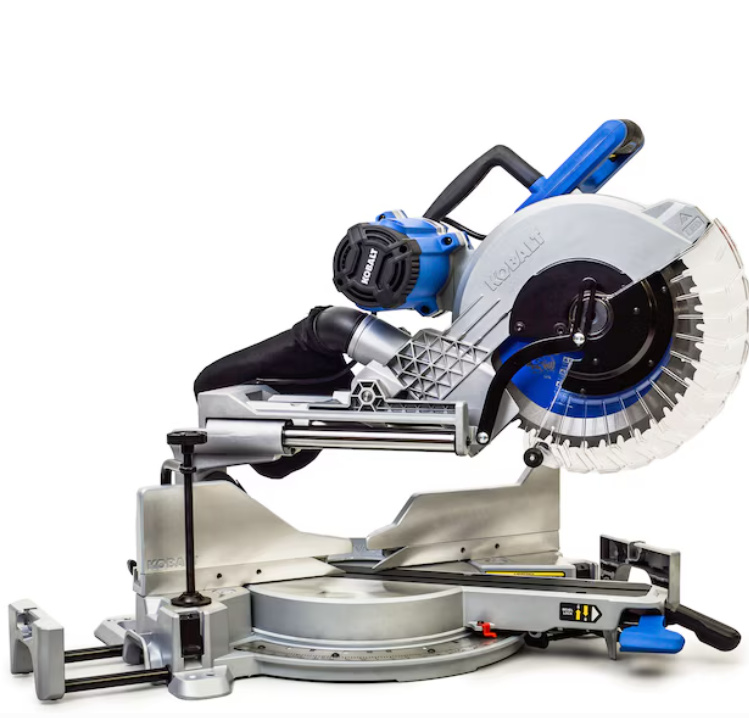
Kobalt Compact 12-in 15-Amp Dual Bevel Sliding Compound Corded Miter Saw
- Maximum crosscut up to 2 in x 16 in (dimensional) at 90 degrees with innovative two position fence design, 2 in x 10 in at 45
- Miter cuts up to 55 degrees left and 60 degrees right with 10 positive stops at most used angles
- Two aluminum extension supports on both sides of table for added stability of workpiece

Kobalt Compact 7-1/4-in 10-Amp Single Bevel Sliding Compound Corded Miter Saw
- Maximum crosscut up to 2-in x 8-in (dimensional) at 90 degrees and 2-in x 6-in at 45, idea for molding and framing cuts
- Upfront LED cut-line indicator projects an accurate pre-cutting line for precise alignment
Unleashing Professional-Grade Power for Every Workshop
When it comes to precision cutting in the workshop, few tools command as much respect as a well-engineered compound miter saw. Among the arsenal of professional-grade equipment available today, the Kobalt Compound Miter Saw stands as a testament to the perfect marriage of affordability and performance. Whether you’re a seasoned craftsman shaping crown molding for a Victorian restoration or a weekend warrior building your first deck, understanding the capabilities and nuances of this remarkable tool can transform your woodworking journey from frustrating fumbles to masterful precision.
The world of power tools is littered with promises of revolutionary performance and game-changing features, but the Kobalt brand has consistently delivered on its commitment to providing professional-quality tools without the premium price tag. In an industry where a single tool can make or break a project, the Kobalt Compound Miter Saw emerges as a reliable workhorse that doesn’t sacrifice accuracy for affordability.
The Art and Science of Compound Miter Cutting
Before diving into the specifics of what makes the Kobalt Compound Miter Saw exceptional, it’s essential to understand the fundamental purpose and versatility of this tool. At its core, a compound miter saw is designed to make precise crosscuts and miter cuts in wood, plastic, and certain metals. The term “compound” refers to the saw’s ability to tilt the blade to create bevel cuts while simultaneously making miter cuts, effectively cutting material at compound angles.
What is the Kobalt Compound Miter Saw used for? This versatile machine excels in numerous applications that demand precision and repeatability. Picture yourself installing baseboards throughout your home – the Kobalt Compound Miter Saw allows you to create perfect inside and outside corners with its precise miter adjustments. When building picture frames, the saw’s ability to cut exact 45-degree angles ensures tight, professional joints that would make even master framers envious.
The saw truly shines in trim work, where accuracy is paramount. Crown molding, chair rails, and window casings all require compound cuts that combine both miter and bevel angles. Traditional hand saws or even basic miter boxes simply cannot achieve the consistency and precision that complex architectural elements demand. The Kobalt Compound Miter Saw transforms these challenging cuts into routine operations.
For furniture makers, the saw serves as an invaluable tool for creating clean crosscuts on large boards and precise angles for joints. Cabinet makers rely on its accuracy for face frame construction, while deck builders appreciate its ability to handle larger dimensional lumber with confidence. Even metal fabricators find value in the saw when working with aluminum trim or steel studs, provided they use the appropriate blade.
Navigating the Marketplace: Where to Find Your Perfect Match
The modern tool marketplace offers countless purchasing options, each with its own advantages and considerations. Where can I buy a Kobalt Compound Miter Saw? The primary retail destination for Kobalt tools is Lowe’s Home Improvement stores, where the brand enjoys exclusive distribution rights. This exclusivity means that whether you’re shopping at a massive big-box location or a smaller neighborhood store, Lowe’s provides the most comprehensive selection of Kobalt products.
The advantage of purchasing from Lowe’s extends beyond mere availability. Their knowledgeable staff can provide hands-on demonstrations, allowing you to experience the saw’s operation before making your investment. The store’s return policy and customer service infrastructure also provide peace of mind for such a significant purchase.
Online purchasing through Lowe’s website offers convenience and often features exclusive web-only deals. The digital platform provides detailed specifications, customer reviews, and comparison tools that can inform your decision-making process. Many models qualify for free shipping to your local store, combining online convenience with the security of in-person pickup.
Third-party marketplaces occasionally feature Kobalt saws, particularly in the used equipment segment. However, buyers should exercise caution when purchasing from these sources, as warranty coverage and authenticity cannot always be guaranteed. Professional tool rental shops sometimes sell their fleet equipment, offering well-maintained saws at reduced prices for budget-conscious buyers.
Investment Analysis: Understanding the Value Proposition
Tool purchases represent significant investments in your workshop’s capability, making cost analysis crucial for informed decision-making. How much does a Kobalt Compound Miter Saw cost? The pricing structure reflects Kobalt’s positioning as a premium value brand, typically ranging from approximately $200 for basic 10-inch models to $500 for feature-rich 12-inch variants with advanced capabilities.
Entry-level models focus on essential functionality, providing accurate cuts without premium features like laser guides or extensive dust collection systems. These saws serve hobbyists and occasional users who prioritize affordability while maintaining quality standards. Mid-range offerings introduce enhanced features such as improved fence systems, better dust management, and more precise adjustment mechanisms.
Professional-grade models command higher prices but deliver correspondingly advanced capabilities. These saws feature larger cutting capacities, superior motor performance, and sophisticated fence and measurement systems. The investment proves worthwhile for contractors and serious woodworkers who demand maximum versatility and durability from their equipment.
Seasonal promotions and holiday sales often provide opportunities for significant savings. Spring home improvement seasons and fall contractor preparation periods frequently feature attractive pricing. Smart shoppers monitor these cycles to maximize their tool budget effectiveness.
Essential Equipment: What’s Included and What’s Not
Understanding what comes with your purchase prevents unpleasant surprises and helps budget for additional necessary components. Does the Kobalt Compound Miter Saw come with a blade? Yes, Kobalt includes a general-purpose carbide-tipped blade with each saw, typically featuring 40 to 60 teeth depending on the model size. This blade provides excellent performance for common crosscutting tasks in softwood and hardwood materials.
However, the included blade represents a starting point rather than the ultimate cutting solution. Serious users quickly discover that specialized blades dramatically improve performance for specific materials and applications. Fine-tooth blades excel at cutting plywood and preventing tear-out, while aggressive tooth configurations speed through rough lumber. Metal-cutting blades transform the saw into a versatile tool for aluminum and steel work.
The saw package typically includes essential accessories such as blade wrenches, instruction manuals, and basic safety equipment. Some models feature additional components like workpiece clamps, extension tables, or measurement guides. Higher-end variants may include premium accessories that would otherwise require separate purchases.
Professional users often view the included blade as temporary equipment, immediately upgrading to premium options that match their specific needs. This approach maximizes the saw’s potential while ensuring optimal cut quality from the first project.
Sizing Your Success: Choosing the Right Blade Diameter
The blade diameter fundamentally determines your saw’s cutting capacity and overall capability. What sizes are available for the Kobalt Compound Miter Saw? The lineup primarily features 10-inch and 12-inch models, each designed to serve different user needs and workshop requirements.
Ten-inch models excel in portability and precision for most residential and light commercial applications. Their smaller blade diameter results in lighter overall weight, making them easier to transport between job sites or store in compact workshops. The reduced size doesn’t significantly impact cutting capacity for standard lumber sizes, easily handling 2×8 dimensional lumber and most trim materials.
Twelve-inch variants provide maximum cutting capacity for users who regularly work with larger materials. The increased blade diameter allows deeper cuts in thick stock and wider cuts in dimensional lumber. Professional contractors and furniture makers often prefer 12-inch models for their versatility when working with diverse material sizes.
The choice between sizes involves balancing cutting capacity against portability and cost considerations. Larger saws consume more workshop space and require more robust support structures. Their increased power demands may also necessitate dedicated electrical circuits in some workshop environments.
Consider your typical project requirements when selecting blade size. If your work primarily involves trim, molding, and standard lumber, a 10-inch model provides excellent performance with enhanced portability. Projects involving large timbers, thick hardwood slabs, or extensive dimensional lumber benefit from 12-inch capacity.
Professional Applications: Meeting Commercial Demands
The distinction between consumer and professional tools often centers on durability, precision, and consistent performance under demanding conditions. Is the Kobalt Compound Miter Saw suitable for professional woodworking? The answer depends largely on the specific model selected and the nature of professional demands placed upon it.
Kobalt’s higher-end models incorporate features that satisfy many professional requirements. Robust motor construction provides the sustained power necessary for extended use periods. Precision fence systems ensure repeatable accuracy across hundreds of cuts. Quality bearings and construction materials deliver the longevity that professional use demands.
Professional trim carpenters frequently rely on Kobalt Compound Miter Saws for finish work where accuracy trumps raw power. The saw’s ability to produce smooth, splinter-free cuts in hardwood trim makes it valuable for high-end residential and commercial projects. Cabinet shops often integrate these saws into their workflow for crosscutting operations and angle work.
However, some professional applications may exceed the saw’s design parameters. Heavy production environments with continuous operation might benefit from more robust industrial models. Specialized applications requiring exotic materials or extreme precision may necessitate purpose-built equipment.
The key lies in matching the tool to the application. For professional users whose work aligns with the saw’s strengths, the Kobalt Compound Miter Saw provides exceptional value and performance. Those with specialized or extreme demands should carefully evaluate whether the saw meets their specific requirements.
Understanding Sliding Capabilities: Fixed vs. Sliding Designs
The distinction between standard compound miter saws and sliding variants significantly impacts cutting capacity and versatility. What is the difference between a Kobalt Compound Miter Saw and a sliding miter saw? The fundamental difference lies in the cutting mechanism and resulting capacity limitations.
Standard compound miter saws feature fixed cutting heads that pivot down through the material. This design limits cutting width to the blade’s reach from the pivot point, typically accommodating boards up to 8 inches wide depending on the angle. While this limitation affects some applications, the fixed design offers advantages in precision and setup simplicity.
Sliding compound miter saws incorporate rails that allow the cutting head to move forward and backward during the cutting motion. This sliding action dramatically increases crosscut capacity, enabling cuts through boards up to 12 inches wide or even larger. The additional capacity proves invaluable when working with wide crown molding, large dimensional lumber, or sheet goods.
Kobalt’s lineup includes both fixed and sliding models, allowing users to select the design that best matches their needs. Fixed models excel in applications where maximum precision and compact size matter most. Their simpler construction often translates to enhanced accuracy and reduced maintenance requirements.
Sliding models sacrifice some precision for increased versatility. The additional mechanical complexity can introduce slight variations in cut quality, particularly if the sliding mechanism develops wear over time. However, for users who regularly encounter wide materials, the increased capacity justifies these trade-offs.
Precision Enhancement: Laser Guide Technology
Modern miter saws increasingly incorporate technological features that enhance cutting accuracy and user confidence. Does the Kobalt Compound Miter Saw have a laser guide? Many models in the Kobalt lineup feature integrated laser systems that project a red line onto the workpiece, indicating exactly where the blade will cut.
The laser guide transforms the cutting experience from one of careful measurement and marking to intuitive alignment. Users can position their material by aligning the cut line with the laser projection, eliminating the need for complex marking procedures. This feature proves particularly valuable when making multiple identical cuts or working with expensive materials where mistakes prove costly.
However, laser systems require proper calibration to ensure accuracy. Environmental factors such as ambient lighting can affect laser visibility, sometimes making the guide difficult to see in bright workshop conditions. Dust and debris can also obscure the laser emission point, requiring regular cleaning to maintain effectiveness.
Professional users often develop techniques that combine laser guidance with traditional measuring methods. The laser serves as a quick reference for rough positioning, while careful measurement ensures ultimate precision. This hybrid approach maximizes both speed and accuracy in professional applications.
Battery-powered laser systems require periodic replacement, adding to long-term operating costs. Some users find the laser more useful for rough cutting than finish work, where traditional measuring and marking techniques provide superior precision.
Mastering Angle Adjustments: Precision Control Systems
The ability to make precise angle adjustments distinguishes quality miter saws from basic cutting tools. How do I adjust the angles on a Kobalt Compound Miter Saw? The adjustment system varies between models but generally involves separate controls for miter and bevel angles.
Miter angle adjustment typically features a large control handle or lever that releases the saw’s base rotation mechanism. Positive stops at common angles such as 0, 15, 22.5, 30, and 45 degrees provide quick positioning for standard cuts. Fine adjustment capabilities allow precise positioning at any angle within the saw’s range, typically spanning 45 degrees in each direction from square.
Bevel angle adjustment involves a separate mechanism that tilts the entire cutting head. Most models feature positive stops at 0 and 45 degrees, with some offering additional stops at commonly used angles. The bevel range typically extends from 0 to 45 degrees in one direction, though some models provide dual bevel capability for enhanced versatility.
Quality adjustment systems incorporate clear, easy-to-read scales with fine graduation marks. Pointer systems should align precisely with scale markings, and positive stops should engage cleanly without requiring excessive force. Any sloppiness in the adjustment mechanism directly translates to cutting inaccuracy.
Regular maintenance of adjustment mechanisms ensures continued precision. Accumulated sawdust can interfere with smooth operation, while worn components may introduce play that affects accuracy. Proper lubrication and cleaning according to manufacturer specifications maintains optimal performance throughout the saw’s service life.
Cutting Capacity: Understanding Dimensional Limits
The maximum cutting capacity defines the range of materials your saw can accommodate, directly impacting its utility for various projects. What is the maximum cutting capacity of the Kobalt Compound Miter Saw? The capacity varies significantly between models and depends on whether measurements refer to crosscut width, depth of cut, or compound cutting scenarios.
Ten-inch models typically crosscut materials up to 4.5 inches thick and 6 to 8 inches wide when cutting at 90 degrees. These specifications accommodate most common lumber sizes including 2×6 and 2×8 dimensional lumber, standard molding profiles, and typical trim materials. When cutting at 45-degree miter angles, the width capacity reduces proportionally due to geometric constraints.
Twelve-inch models provide enhanced capacity, typically accommodating materials up to 6 inches thick and 8 to 12 inches wide. This increased capacity proves valuable when working with large crown molding, thick hardwood stock, or engineered lumber products. The additional capacity also provides flexibility when cutting compound angles on larger materials.
Sliding models dramatically increase crosscut width capacity, often accommodating materials 12 inches wide or larger. However, the depth capacity remains limited by the blade diameter and motor housing clearance. Understanding these limitations prevents purchasing materials that exceed your saw’s capabilities.
Compound cutting scenarios further reduce effective capacity as the blade must clear the workpiece at multiple angles simultaneously. Always consult the manufacturer’s capacity charts when planning projects that involve complex angles or large materials. These charts provide realistic expectations and help avoid costly mistakes during material planning phases.
Portability Considerations: Workshop vs. Job Site Performance
The balance between cutting capability and portability significantly influences tool selection for different user scenarios. Is the Kobalt Compound Miter Saw portable? The answer depends largely on the specific model and individual definitions of portability.
Smaller 10-inch models typically weigh between 35 and 50 pounds, making them manageable for single-person transport. Many feature carrying handles and compact designs that facilitate movement between job sites or workshop locations. However, even these “portable” models require substantial support surfaces and stable setup procedures for safe operation.
Twelve-inch models and sliding variants often exceed 60 pounds, challenging the practical limits of portability for many users. Their increased size and weight demand more robust transport solutions and setup procedures. Professional contractors sometimes use dedicated stands or carts to enhance mobility while maintaining operational stability.
True portability extends beyond mere weight to include setup requirements and support needs. Even lightweight saws require level surfaces, adequate clearance, and secure mounting for safe operation. Portable miter saw stands address many of these concerns, providing stable platforms that can be quickly deployed at job sites.
Workshop-based users often prioritize cutting capacity and precision over portability, accepting heavier, more capable models in exchange for enhanced performance. Job site professionals must carefully balance these competing demands, sometimes maintaining separate tools optimized for specific scenarios.
Dust Management: Maintaining Clean Work Environments
Effective dust collection significantly impacts both workshop cleanliness and cutting visibility during operation. Does the Kobalt Compound Miter Saw come with a dust collection system? Most models include basic dust collection features, though the sophistication varies considerably between price points and model configurations.
Entry-level models typically feature dust ports compatible with shop vacuum connections. These ports channel a significant portion of generated dust directly into collection systems, dramatically reducing airborne particles and workspace contamination. However, the effectiveness depends heavily on the connected vacuum’s capacity and airflow characteristics.
Higher-end models may incorporate more sophisticated dust management systems including collection bags, multiple collection points, and enhanced airflow designs. These systems capture dust more effectively and provide options for users without dedicated shop vacuum systems.
The blade guard design significantly influences dust collection effectiveness. Well-designed guards direct dust flow toward collection points while maintaining optimal cutting visibility. Poorly designed systems may scatter dust throughout the workspace despite collection system presence.
Even the best integrated dust collection systems cannot eliminate all sawdust generation. Supplementary measures such as ambient air filtration and personal protective equipment remain essential for complete dust management. Professional shops often combine multiple approaches to maintain optimal air quality and workspace cleanliness.
Competitive Analysis: Kobalt vs. Industry Leaders
Understanding how the Kobalt Compound Miter Saw compares to established competitors helps inform purchasing decisions and set realistic expectations. How does the Kobalt Compound Miter Saw compare to other brands like DeWalt or Makita? The comparison reveals both strengths and limitations across different performance categories.
DeWalt and Makita represent premium brands with extensive professional reputations built over decades of tool development. Their miter saws typically feature more robust construction, advanced precision systems, and comprehensive feature sets. However, this enhanced capability comes with correspondingly higher prices that may exceed many users’ budgets.
Kobalt positions itself as a value-oriented alternative that delivers essential functionality without premium pricing. The saw’s accuracy and build quality often surprise users familiar with other budget-oriented tools. While it may not match the ultimate refinement of premium brands, it provides excellent performance for its price category.
Motor performance represents one area where differences become apparent. Premium brands often feature more powerful motors with better thermal management and longer service lives. Kobalt motors provide adequate power for most applications but may struggle with the most demanding continuous-use scenarios that professional contractors encounter daily.
Precision systems show similar patterns, with premium brands offering more sophisticated fence designs and adjustment mechanisms. Kobalt’s systems provide good accuracy for most users while maintaining simplicity that reduces maintenance requirements and potential failure points.
Power Options: Corded Reliability vs. Cordless Convenience
The power source significantly influences tool performance, portability, and operational flexibility. Is the Kobalt Compound Miter Saw corded or cordless? Kobalt offers both configurations, allowing users to select the power option that best matches their specific needs and working environments.
Corded models provide unlimited runtime and consistent power delivery throughout extended cutting sessions. The continuous power supply ensures that motor performance never degrades due to battery depletion, making corded saws ideal for high-volume cutting applications and workshop environments with reliable electrical access.
The corded design also eliminates concerns about battery maintenance, replacement costs, and charging logistics. Professional contractors working in established workshops or job sites with electrical infrastructure often prefer corded models for their reliability and consistent performance characteristics.
Cordless variants sacrifice some power and runtime for enhanced portability and convenience. Modern battery technology provides impressive performance for moderate-duty applications, though heavy cutting tasks may quickly deplete battery reserves. The cordless design excels in remote locations, quick setup scenarios, and situations where electrical access is limited or unavailable.
Battery compatibility within Kobalt’s larger tool ecosystem provides additional value for users who own multiple cordless tools. Shared battery platforms reduce overall system costs and simplify charging logistics. However, the initial investment in batteries and chargers can significantly increase the total system cost compared to corded alternatives.
Protection and Assurance: Understanding Warranty Coverage
Warranty protection provides crucial peace of mind for significant tool investments while indicating manufacturer confidence in product quality. What is the warranty on the Kobalt Compound Miter Saw? Kobalt typically provides comprehensive warranty coverage that reflects industry standards while offering some distinctive advantages.
Most Kobalt miter saws include a three-year manufacturer warranty covering defects in materials and workmanship. This coverage period exceeds many competitors’ standard warranties, demonstrating Kobalt’s confidence in their manufacturing quality and component selection. The warranty covers repair or replacement of defective components during normal use scenarios.
The warranty specifically excludes damage from misuse, normal wear items such as blades and brushes, and modifications that alter the tool’s original configuration. Understanding these limitations helps users maintain warranty coverage while ensuring proper tool care and operation.
Lowe’s relationship with Kobalt provides additional warranty advantages through their extensive store network. Warranty service can often be initiated at local stores rather than requiring direct manufacturer contact. This convenience significantly reduces service logistics and minimizes tool downtime during warranty claims.
Extended warranty options may be available through Lowe’s protection plans, providing additional coverage beyond the standard manufacturer warranty. These plans often include coverage for accidental damage and normal wear, though users should carefully evaluate the cost versus benefit of extended coverage.
Parts and Service: Long-Term Support Considerations
The availability of replacement parts and accessories significantly influences a tool’s long-term value and service life. Are replacement parts and accessories available for the Kobalt Compound Miter Saw? Kobalt maintains an extensive parts and accessories program that supports their tool lineup throughout its expected service life.
Common maintenance items such as brushes, belts, and switches are readily available through Lowe’s stores and their online ordering system. More specialized components may require special ordering but remain accessible for most models within the active product lineup. This parts availability ensures that minor component failures don’t necessitate complete tool replacement.
The accessory ecosystem includes various upgrades and enhancements that can improve saw performance or expand its capabilities. Specialized blades, improved fence systems, and enhanced dust collection components allow users to customize their saws for specific applications or preferences.
Third-party manufacturers also produce compatible accessories and replacement parts, providing alternative sources for common components. However, users should verify compatibility and quality before installing non-OEM parts to avoid warranty issues or performance problems.
Professional service networks provide repair capabilities for more complex issues that exceed typical user maintenance skills. Authorized service centers have access to technical documentation and specialized tools necessary for proper repair procedures.
Advanced Cutting Techniques: Bevel Capabilities
The ability to make precise bevel cuts significantly expands a miter saw’s versatility for complex woodworking projects. Can the Kobalt Compound Miter Saw make bevel cuts? Yes, this capability represents one of the key features that distinguish compound miter saws from basic miter saws.
Bevel cutting involves tilting the blade to cut through material at an angle other than 90 degrees. This capability proves essential for creating compound joints in crown molding, picture frames, and furniture construction. The Kobalt Compound Miter Saw typically provides bevel adjustments from 0 to 45 degrees, accommodating the vast majority of common bevel cutting requirements.
Single bevel models tilt the blade in one direction only, requiring users to flip workpieces when cutting complementary angles. This approach works well for most applications while maintaining simplicity and affordability. Double bevel models tilt in both directions, eliminating the need to reposition workpieces and speeding up complex cutting operations.
The bevel mechanism’s precision directly affects cut quality and joint fit in finished projects. Quality systems provide smooth, accurate adjustments with positive stops at common angles. The bevel scale should be clearly marked and easily readable from normal operating positions.
Compound cuts that combine both miter and bevel angles represent the most challenging cutting scenarios. These cuts require careful setup and may push the saw’s capacity limits depending on material size and angle combinations. Understanding these limitations prevents attempting cuts that exceed the saw’s capabilities.
Maintenance and Care: Preserving Performance
Proper maintenance ensures continued accuracy and extends service life while preventing costly repairs or premature replacement. How do I maintain and clean a Kobalt Compound Miter Saw? Regular maintenance involves several key areas that require attention to maintain optimal performance.
Blade maintenance represents the most critical aspect of saw care. Sharp blades produce cleaner cuts with less strain on the motor while reducing tear-out and burning. Regular inspection for damaged or dull teeth helps determine when replacement becomes necessary. Cleaning resin and pitch buildup from blade teeth restores cutting performance between replacements.
The fence and base surfaces require regular cleaning to maintain smooth operation and accurate cuts. Accumulated sawdust can interfere with workpiece positioning and create inaccuracies. Periodic waxing of metal surfaces reduces friction and prevents rust in humid environments.
Motor air vents need regular cleaning to prevent overheating during extended use sessions. Compressed air effectively removes sawdust that accumulates around cooling fins and air intake areas. Brush inspection and replacement according to manufacturer schedules prevents motor damage from excessive wear.
Adjustment mechanisms benefit from periodic lubrication according to manufacturer specifications. However, over-lubrication can attract sawdust and create operational problems. Follow specified lubricant types and quantities to maintain smooth operation without creating contamination issues.
Initial Setup: Calibration Requirements
Achieving optimal cutting accuracy often requires initial setup and calibration procedures that verify and adjust the saw’s precision. Does the Kobalt Compound Miter Saw require calibration out of the box? While Kobalt saws typically arrive with reasonable factory settings, checking and adjusting key measurements ensures maximum accuracy from the first cut.
Fence alignment verification ensures that the fence provides accurate support for workpieces during cutting operations. A misaligned fence can cause binding, inaccurate cuts, and potential safety hazards. Simple measurement techniques using precision squares and straightedges can verify fence accuracy and guide adjustment procedures.
Blade alignment checking ensures that the blade cuts perpendicular to the fence when set to 90 degrees. Minor adjustments may be necessary to achieve perfect alignment, particularly after shipping and handling stresses. This calibration directly affects the accuracy of all subsequent cuts.
Miter and bevel angle verification ensures that the saw’s positive stops align with actual cutting angles. Digital angle gauges provide precise measurements for this calibration process. Small adjustments to stop positions can significantly improve cutting accuracy for common angles.
Some users prefer to perform comprehensive calibration procedures immediately upon setup, while others make adjustments as accuracy issues become apparent during use. Professional users typically invest time in thorough initial setup to ensure maximum accuracy from the beginning of their saw’s service life.
Timing Your Purchase: Sales and Promotions
Strategic purchasing timing can result in significant savings on tool investments. Do Kobalt Compound Miter Saws go on sale? Yes, Kobalt tools regularly participate in Lowe’s promotional programs throughout the year, providing opportunities for substantial discounts.
Spring home improvement seasons typically feature attractive tool promotions as retailers prepare for increased contractor and homeowner activity. These sales often include both individual tool discounts and bundle deals that provide additional value for users building comprehensive tool collections.
Holiday periods such as Memorial Day, Independence Day, and Labor Day commonly feature significant tool promotions. Black Friday and spring clearance events may offer the deepest discounts, though selection may be limited to specific models or configurations.
Professional contractor events provide targeted promotions for commercial users, often including volume discounts and extended payment terms. These events typically occur during fall months as contractors prepare for upcoming construction seasons.
Monitoring Lowe’s website and promotional materials helps identify upcoming sales events and plan purchases accordingly. Email newsletters and mobile app notifications provide advance notice of sales and exclusive promotions for registered users.
Conclusion: Embracing Precision in Your Workshop
The Kobalt Compound Miter Saw represents more than just another tool in the workshop – it embodies the democratization of precision cutting capabilities that were once reserved for professional shops with premium budgets. Through careful engineering and thoughtful design, Kobalt has created a tool that serves both the aspiring craftsman taking their first steps into serious woodworking and the experienced professional seeking reliable performance without premium pricing.
Understanding the nuances of this remarkable tool – from its cutting capabilities and adjustment mechanisms to its maintenance requirements and competitive positioning – empowers users to make informed decisions that align with their specific needs and workshop demands. The saw’s versatility in handling everything from delicate trim work to robust dimensional lumber speaks to its thoughtful design and engineering excellence.
As you consider adding the Kobalt Compound Miter Saw to your workshop arsenal, remember that the tool itself is merely the foundation upon which your craftsmanship skills will flourish. The precision it provides becomes meaningful only when combined with careful measurement, thoughtful project planning, and dedication to quality workmanship.
Whether you’re embarking on your first major woodworking project or adding to an already impressive tool collection, the Kobalt Compound Miter Saw offers the reliability, accuracy, and value that transform ambitious project plans into tangible reality. In a world where precision matters and budgets require careful consideration, this saw delivers the performance that brings your creative visions to life, one perfectly cut piece at a time.