
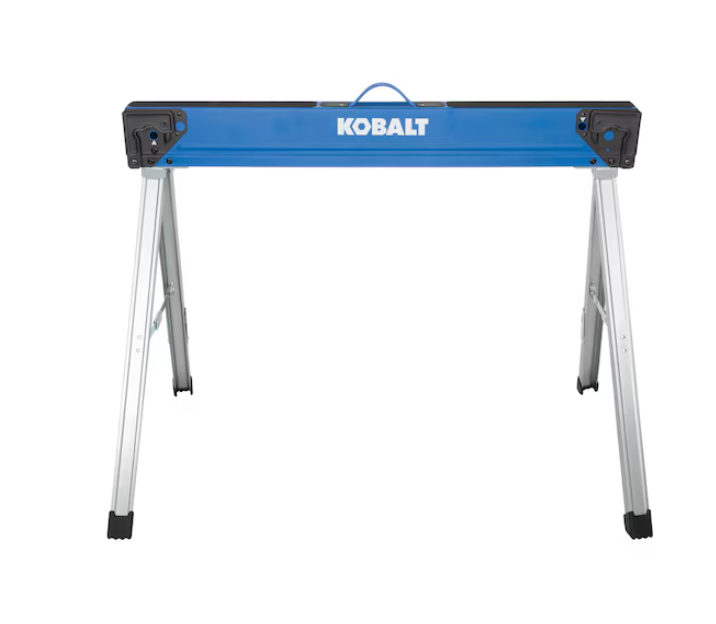
Kobalt 43-in W x 30-in H Steel Saw Horse ( 1100-lb Capacity)
- Load capacity is 1100 lbs per sawhorse, and when paired, can safely hold up to 2200 lbs
- All legs have a fixed, non-adjustable length of 27 inches
- Height when fully set up is 30 inches, and when paired, creates a helpful work space
- Non-marring feet help to stabilize the sawhorse and will help protect finished flooring
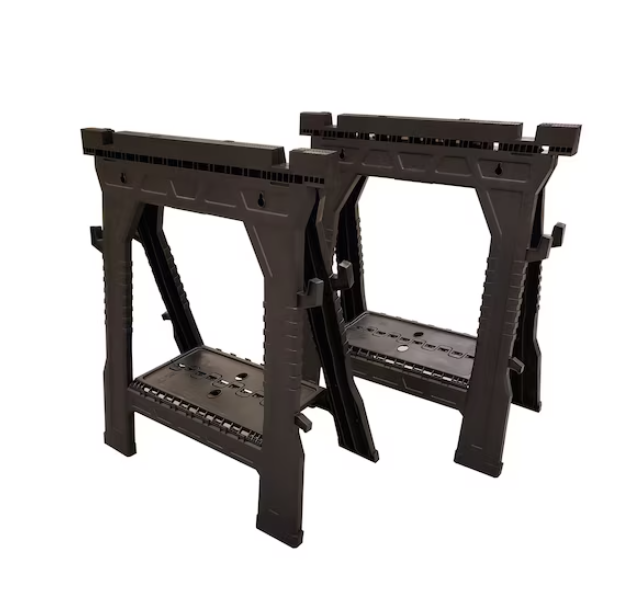
Kobalt 2 -Pack 27-in W x 32-in H Plastic Saw Horse ( 1000-lb Capacity)
- Kobalt 2-pack plastic saw horses provide a sturdy frame to safely support material for projects
- Supports up to 1,000-lb when used as a pair to take on heavier items, like doors and plywood
- Side hangers hold cables, and the bottom shelf holds tools for convenience
- Non-skid feet provide traction to prevent the saw horse from slipping
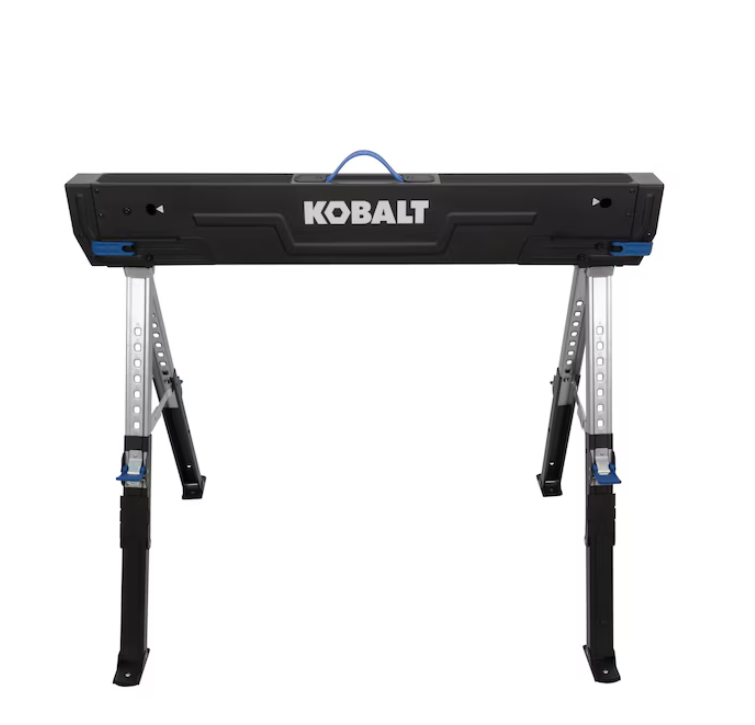
Kobalt 38-in W x 32.2-in H Adjustable Steel Saw Horse ( 1300-lb Capacity)
- Load capacity of up to 1300 lbs per sawhorse
- All legs are independently adjustable – from 22-in to 32-in – allowing you to use the sawhorse on uneven surfaces if necessary (not recommended)
Discovering Why the Kobalt Saw Horse Has Become Every DIYer’s and Professional’s Secret Weapon for Precision Workmanship
The workshop is a sanctuary where raw materials transform into masterpieces, where creativity meets functionality, and where the right tools can make the difference between frustration and satisfaction. Among the essential arsenal of workshop equipment, few tools command as much respect and utility as the humble yet mighty Kobalt Saw Horse. This isn’t just another piece of workshop furniture—it’s the unsung hero that elevates your projects from amateur attempts to professional-grade craftsmanship.
Picture this: you’re in your garage on a crisp Saturday morning, sunlight streaming through the windows, and before you lies a collection of lumber waiting to be transformed into something extraordinary. Whether you’re building custom shelving, crafting a dining table, or tackling a home renovation project, the foundation of your success rests literally on what supports your work. This is where the Kobalt Saw Horse enters the scene, not with fanfare, but with the quiet confidence of a tool that simply works—and works exceptionally well.
Understanding the Kobalt Saw Horse: More Than Just a Support System
When we talk about what a Kobalt Saw Horse is used for, we’re really discussing the backbone of countless workshop operations. These versatile workhorses serve as the foundation for cutting, sanding, assembly, and countless other workshop tasks that demand stable, reliable support. Think of them as the supporting actors in your workshop drama—they may not be the star of the show, but without them, the entire production falls apart.
The primary function of a Kobalt Saw Horse extends far beyond simply holding materials while you cut them. These robust platforms transform any space into a functional workspace, whether you’re working in a fully equipped workshop, a cramped garage, or even outdoors on a jobsite. They provide the stability needed for precise cuts, the height required for comfortable working positions, and the versatility to adapt to projects ranging from delicate trim work to heavy-duty construction tasks.
Professional contractors have long recognized that the quality of their support system directly impacts the quality of their finished work. A wobbling, inadequate saw horse can turn a simple crosscut into an exercise in frustration, potentially compromising both safety and precision. The Kobalt Saw Horse addresses these concerns with engineering that prioritizes stability, durability, and user-friendly design.
Where to Find Your Perfect Kobalt Saw Horse
The quest for the perfect Kobalt Saw Horse begins with knowing where to look. As a Lowe’s exclusive brand, Kobalt tools and accessories are primarily available through Lowe’s retail locations and their online platform. This exclusivity might initially seem limiting, but it actually works in the consumer’s favor by ensuring consistent availability, pricing, and customer service standards.
Lowe’s extensive network of retail stores means you can physically examine the Kobalt Saw Horse before making your purchase, testing its stability, checking its build quality, and getting a feel for its weight and portability. The hands-on experience is invaluable when selecting tools that will become integral parts of your workshop setup.
For those who prefer the convenience of online shopping, Lowe’s website offers detailed specifications, customer reviews, and often provides additional insights that might not be immediately apparent in a showroom setting. The online platform also frequently features customer photos showing the Kobalt Saw Horse in real-world applications, providing practical context for how these tools perform in actual workshop environments.
Investment Analysis: Understanding Kobalt Saw Horse Pricing
When considering the cost of a Kobalt Saw Horse, it’s important to view the purchase not as an expense, but as an investment in your workshop’s capabilities. Pricing typically falls into the competitive mid-range category, offering professional-grade features without the premium price tag associated with some high-end brands.
The cost structure often reflects the engineering and materials that go into each unit. While exact pricing can fluctuate based on market conditions, seasonal promotions, and regional variations, Kobalt Saw Horses generally offer excellent value proposition when compared to similar products from competing manufacturers. This pricing strategy aligns with Kobalt’s overall brand philosophy of providing professional-quality tools accessible to serious DIYers and budget-conscious professionals.
It’s worth noting that the initial investment in quality saw horses pays dividends over time. A well-built Kobalt Saw Horse can serve faithfully for decades, supporting countless projects and potentially saving money that might otherwise be spent on replacing inferior alternatives. When calculated on a per-project or per-year basis, the cost becomes remarkably reasonable.
Engineering Excellence: Weight Capacity and Structural Design
The weight capacity of a Kobalt Saw Horse represents one of its most critical specifications, directly impacting its utility across different project types. These workhorses are engineered to handle substantial loads, typically supporting several hundred pounds when properly set up and used within their design parameters.
Understanding weight capacity involves more than just knowing the maximum load rating. The distribution of weight, the type of materials being supported, and the working conditions all play crucial roles in determining real-world performance. A Kobalt Saw Horse designed to support 1,000 pounds under ideal conditions might have different practical limitations when supporting uneven loads or when used on uneven surfaces.
The engineering behind this impressive weight capacity involves careful consideration of materials, joint design, and load distribution principles. The legs are positioned and angled to provide maximum stability while maintaining portability. The top beam is designed to distribute loads evenly across the structure, preventing stress concentrations that could lead to failure.
For most workshop applications, the weight capacity of a Kobalt Saw Horse provides substantial overhead, allowing users to work confidently with heavy lumber, sheet goods, and even heavier materials like stone or metal components. This generous capacity also means the saw horses remain stable and secure even when subjected to the dynamic forces created during cutting operations.
Solo or Pair: Understanding Kobalt Saw Horse Packaging Options
The question of whether Kobalt Saw Horses are sold individually or in pairs touches on practical considerations that significantly impact both initial investment and workshop functionality. The packaging approach varies depending on the specific model and promotional considerations, but understanding the options helps in making informed purchasing decisions.
Many Kobalt Saw Horse models are available both individually and in convenient two-packs. The paired packaging often provides better value for money, as most workshop applications require at least two saw horses for effective use. Working with a single saw horse severely limits functionality and can actually compromise safety and work quality.
The individual packaging option serves several important purposes. It allows users to replace a damaged unit without buying an unnecessary second horse, accommodates workshops where space constraints limit storage, and provides flexibility for users who already own compatible saw horses from previous purchases.
When planning a workshop setup, consider that most cutting and assembly operations require two saw horses minimum, with many projects benefiting from three or even four units. The ability to purchase individual units allows for gradual expansion of workshop capabilities without requiring large upfront investments.
Adaptability Through Adjustable Height Settings
Modern workshop demands require tools that adapt to varying project requirements and user preferences. The Kobalt Saw Horse addresses this need through thoughtfully designed height adjustment mechanisms that allow customization for different applications and user comfort levels.
Height adjustability serves multiple practical purposes beyond basic comfort. Different projects require different working heights for optimal results. Fine detail work might benefit from a lower height that brings the work surface closer to eye level, while rough construction work might require a higher setting that reduces back strain during extended periods of activity.
The adjustment mechanism on a Kobalt Saw Horse typically allows for several preset positions, each designed to correspond to common workshop requirements. This standardized approach ensures repeatability—once you find the optimal height for a particular type of project, you can quickly set up your workspace to match those requirements for future similar projects.
The engineering challenge in creating adjustable height systems lies in maintaining structural integrity across all settings. The Kobalt Saw Horse addresses this through robust locking mechanisms that secure the legs in position without introducing play or wobbling that could compromise work quality.
Material Science: The Foundation of Kobalt Quality
The materials used in constructing a Kobalt Saw Horse represent a careful balance between strength, weight, durability, and cost-effectiveness. Modern saw horses incorporate advanced materials science to achieve performance characteristics that would have been impossible with traditional construction methods.
The frame construction typically utilizes high-strength steel components that provide exceptional durability while maintaining reasonable weight. This steel is often treated with protective coatings that resist corrosion and wear, ensuring that the Kobalt Saw Horse maintains its appearance and functionality even after years of heavy use.
Critical connection points and high-stress areas may incorporate reinforced designs or specialized alloys that provide additional strength where it’s needed most. The engineering team at Kobalt analyzes stress patterns and failure modes to identify these critical areas and design appropriate reinforcement strategies.
The choice of materials also impacts the tool’s performance in different environmental conditions. A Kobalt Saw Horse constructed with weather-resistant materials can transition seamlessly between indoor workshop use and outdoor jobsite applications without degradation in performance or premature wear.
Space-Saving Design: Foldability and Storage Solutions
Modern workshops face an ongoing challenge balancing tool capability with space efficiency. The Kobalt Saw Horse addresses this challenge through intelligent design that maximizes functionality while minimizing storage requirements when not in use.
The foldable design represents more than simple convenience—it’s a carefully engineered solution that maintains structural integrity while providing compact storage. The folding mechanism must be robust enough to handle repeated use without developing play or looseness that could compromise stability during work operations.
When folded, a Kobalt Saw Horse can often be stored in surprisingly compact spaces, hanging on workshop walls, sliding under workbenches, or stacking in utility rooms. This space efficiency makes it practical to own multiple units even in smaller workshop environments.
The folding operation itself is designed for quick, tool-free execution. After a long day of workshop activity, the last thing anyone wants is a complicated breakdown procedure. The Kobalt Saw Horse typically folds and unfolds in seconds, encouraging users to properly store their equipment rather than leaving it set up where it might become damaged or create safety hazards.
Competitive Analysis: Kobalt Versus the Field
Understanding how the Kobalt Saw Horse compares to competitive alternatives from brands like DeWalt, ToughBuilt, and others provides valuable context for making informed purchasing decisions. Each manufacturer brings different strengths and design philosophies to their saw horse products, creating a diverse marketplace with options suited to different user needs and preferences.
DeWalt saw horses often emphasize rugged construction and jobsite durability, reflecting the brand’s strong presence in professional construction markets. Their products typically feature heavy-duty construction and may include additional accessories or features targeted at high-volume professional users.
ToughBuilt has carved out a niche with innovative design features and often incorporates advanced materials or unique mechanical designs. Their saw horses might feature distinctive folding mechanisms, integrated storage solutions, or other differentiating characteristics.
The Kobalt Saw Horse positions itself as a balanced solution that combines professional-grade performance with accessibility for serious DIYers. This positioning allows Kobalt to incorporate advanced features while maintaining competitive pricing that makes quality tools available to a broader user base.
When comparing these alternatives, consider factors beyond initial purchase price. Long-term durability, availability of replacement parts, warranty coverage, and compatibility with other workshop tools all contribute to the total cost of ownership and user satisfaction over time.
Accessory Integration and Expansion Capabilities
The versatility of a Kobalt Saw Horse extends beyond its basic support function through thoughtful integration of accessories and expansion capabilities. Modern workshop demands require tools that can adapt and grow with changing project requirements and user skill development.
Many Kobalt Saw Horse models include integrated features for accessory attachment, such as mounting points for clamps, stops, or measuring aids. These integration points transform a basic support platform into a more sophisticated work holding system capable of handling complex assembly and fabrication tasks.
The clamp integration deserves particular attention, as proper work holding represents one of the most critical aspects of safe and accurate workshop operations. When a Kobalt Saw Horse includes built-in clamp mounting options, it enables users to secure workpieces firmly without requiring additional equipment or complicated setups.
Some models may include accessory options like sacrificial top surfaces that protect the saw horse from cuts while providing a renewable cutting surface. Others might offer storage solutions, additional work holding features, or compatibility with brand-specific accessories that enhance functionality for particular types of work.
Dimensional Considerations: Width and Size Specifications
The maximum width capacity of a Kobalt Saw Horse determines its suitability for different types of projects and materials. Understanding these dimensional limitations helps ensure that your investment will serve your specific needs effectively.
Width capacity encompasses both the physical span between legs and the practical working envelope created when two saw horses support a workpiece. A Kobalt Saw Horse with generous width capacity can accommodate sheet goods, long lumber, and wide assemblies without requiring additional support or complicated setup procedures.
The relationship between width capacity and stability requires careful engineering balance. Increasing width capacity generally improves versatility but can impact portability and may require design modifications to maintain structural integrity. The Kobalt Saw Horse design team addresses this challenge through strategic placement of support elements and careful attention to load distribution principles.
Consider your typical project requirements when evaluating width specifications. Furniture makers working with wide panels have different needs than trim carpenters working primarily with narrow stock. The Kobalt Saw Horse aims to provide sufficient capacity for the majority of workshop applications while maintaining practical size and weight characteristics.
Weather Resistance and Outdoor Performance
The ability to use a Kobalt Saw Horse in outdoor environments significantly expands its utility, particularly for contractors, outdoor enthusiasts, and DIYers who lack indoor workshop space. Weather resistance involves both material selection and design features that protect against environmental damage.
Corrosion resistance represents the primary concern for outdoor use. Moisture, temperature fluctuations, and exposure to various atmospheric conditions can quickly degrade tools that lack appropriate protection. The Kobalt Saw Horse typically incorporates protective coatings and corrosion-resistant materials that maintain performance even after exposure to challenging conditions.
UV resistance becomes important for tools that might be stored outdoors or used in sunny conditions for extended periods. Ultraviolet radiation can degrade certain materials, particularly plastics and some coatings. Quality outdoor-capable saw horses include materials and treatments designed to resist UV damage.
Temperature cycling presents another challenge, as repeated expansion and contraction can stress connections and joints. The Kobalt Saw Horse design accounts for these thermal effects through appropriate material selection and joint design that accommodates movement without loosening or failure.
Portability and Weight Considerations
The portability of a Kobalt Saw Horse significantly impacts its practical utility, particularly for users who transport tools between different work locations. The balance between structural capability and lightweight design represents one of the key engineering challenges in saw horse development.
Modern materials and design techniques allow the Kobalt Saw Horse to achieve impressive strength-to-weight ratios. Advanced steel alloys, efficient structural designs, and elimination of unnecessary material all contribute to reducing weight without compromising performance.
Portability involves more than just weight considerations. The folded dimensions, carry handles or grips, and overall ergonomics of transport all impact how easily users can move their equipment. A Kobalt Saw Horse that folds to compact dimensions with convenient carrying features encourages users to bring proper support equipment to every job, improving both safety and work quality.
The relationship between portability and stability requires careful balance. Extremely lightweight designs might sacrifice stability or durability, while overly heavy designs discourage transport and setup. The Kobalt Saw Horse aims to optimize this balance for typical user requirements and application patterns.
Stability Enhancement: Non-Slip Feet and Base Design
Stability represents perhaps the most critical performance characteristic of any saw horse, directly impacting both safety and work quality. The Kobalt Saw Horse incorporates multiple design features that enhance stability across different working conditions and surface types.
Non-slip feet provide the foundation for stable operation by increasing friction between the saw horse and the supporting surface. These specialized feet often incorporate advanced materials that maintain grip on various surface types, from smooth concrete to rough wooden decking.
The base design itself contributes significantly to stability through strategic leg placement and angle optimization. Wide-spread legs provide a broad support base that resists tipping, while the specific angle and length of legs influences how the saw horse responds to various loading conditions.
Dynamic stability during cutting operations requires special consideration, as the forces generated by power tools can create vibration and movement that might not be apparent under static loading conditions. The Kobalt Saw Horse design addresses these dynamic forces through appropriate mass distribution and structural damping characteristics.
Assembly Process: User-Friendly Setup
The assembly process for a Kobalt Saw Horse reflects the manufacturer’s understanding that tools should enhance productivity rather than create barriers to getting work done. Modern consumers expect equipment that can be assembled quickly without requiring specialized knowledge or excessive time investment.
Most Kobalt Saw Horse models feature intuitive assembly procedures that can be completed with basic hand tools. Clear instructions, logical component organization, and well-designed connection systems minimize the potential for confusion or errors during setup.
The initial assembly represents only one aspect of user-friendliness. The Kobalt Saw Horse design also considers long-term serviceability, ensuring that users can perform routine maintenance, replace worn components, or make adjustments without requiring professional service.
Quality control in the manufacturing process ensures that components fit together properly without excessive force or adjustment. Precise manufacturing tolerances and consistent quality standards minimize assembly frustrations and ensure that the finished product performs as designed.
Warranty Protection and Customer Support
The warranty coverage for a Kobalt Saw Horse reflects the manufacturer’s confidence in their product quality and provides users with protection against defects or premature failure. Understanding warranty terms helps users make informed decisions and ensures they receive the protection they deserve.
Typical warranty coverage includes protection against manufacturing defects and material failures under normal use conditions. This coverage recognizes that quality tools should provide years of reliable service when used appropriately and maintained properly.
The warranty claim process should be straightforward and user-friendly, minimizing the burden on customers who experience legitimate problems. Kobalt’s association with Lowe’s provides users with accessible service locations and established customer service procedures that facilitate warranty claims when necessary.
Beyond formal warranty coverage, the availability of replacement parts and ongoing support contributes to long-term user satisfaction. A Kobalt Saw Horse backed by readily available parts and knowledgeable customer service represents a better long-term investment than alternatives with limited support infrastructure.
Expandable Workspace: Connecting Multiple Units
The ability to connect multiple Kobalt Saw Horse units creates expanded work surfaces that can accommodate larger projects and more complex assemblies. This expandability transforms individual saw horses from simple support platforms into components of a comprehensive workspace system.
Connection systems vary among different saw horse designs, but the most effective systems allow secure joining without compromising the stability or load capacity of individual units. Some designs feature mechanical connections that lock units together, while others rely on accessory components that span between separate horses.
When multiple Kobalt Saw Horses work together, the combined system can support larger panels, longer assemblies, and more complex projects than individual units could handle alone. This scalability makes it practical to start with a basic two-horse setup and expand capabilities as projects and skills develop.
The planning required for multi-horse setups involves consideration of workspace layout, project requirements, and storage capabilities. Users who frequently work on large projects benefit from owning multiple units, while occasional users might prefer to start with a basic setup and add units as needed.
Professional Applications and Construction Use
The suitability of Kobalt Saw Horses for professional construction work depends on their ability to meet the demanding requirements of commercial jobsites, high-volume use, and integration with professional workflows. Professional users evaluate tools differently than hobbyists, focusing on reliability, efficiency, and long-term cost considerations.
Professional construction environments subject tools to intensive use, harsh conditions, and demanding performance requirements. A Kobalt Saw Horse designed for professional use must maintain accuracy and stability even after extensive use and exposure to challenging conditions.
The time efficiency considerations that drive professional tool selection favor equipment that sets up quickly, performs reliably, and requires minimal maintenance. Professionals cannot afford equipment failures that delay projects or compromise work quality, making reliability a critical selection criterion.
Integration with other professional tools and systems represents another important consideration. Professional users often develop standardized equipment sets and workflow procedures that maximize efficiency and minimize setup time. The Kobalt Saw Horse must fit effectively into these established patterns to gain acceptance in professional markets.
Timing Your Purchase: Sales and Promotional Opportunities
Understanding when Kobalt Saw Horses typically go on sale helps budget-conscious users maximize their investment and acquire quality tools at attractive prices. Retail patterns, seasonal considerations, and promotional strategies all influence pricing throughout the year.
Major retail holidays often feature tool promotions that include saw horses and other workshop equipment. Events like Memorial Day, Labor Day, and Black Friday frequently offer opportunities to purchase Kobalt Saw Horses at reduced prices or with valuable bonus accessories.
Seasonal patterns reflect the natural rhythms of construction and workshop activity. Spring promotions often target users preparing for summer projects, while fall sales may focus on users setting up workshops for winter indoor activities.
New product introductions sometimes create opportunities to purchase previous-generation Kobalt Saw Horses at reduced prices. While newer models may offer improved features, previous generations often provide excellent value for users whose requirements don’t demand the latest innovations.
Long-Term Care: Maintenance and Cleaning Procedures
Proper maintenance and cleaning procedures ensure that a Kobalt Saw Horse provides years of reliable service while maintaining its appearance and functionality. Regular care prevents minor issues from developing into major problems and protects the investment represented by quality workshop equipment.
Cleaning procedures should address both functional and aesthetic concerns. Removing sawdust, dirt, and debris prevents accumulation that could interfere with folding mechanisms or create premature wear. Regular cleaning also allows users to inspect their equipment for developing issues that might require attention.
Lubrication of moving parts, particularly folding mechanisms and adjustment features, maintains smooth operation and prevents premature wear. The Kobalt Saw Horse design typically minimizes lubrication requirements while providing clear guidance for necessary maintenance procedures.
Storage considerations impact long-term durability, particularly for users who don’t use their saw horses regularly. Proper storage protects against moisture, extreme temperatures, and physical damage that could occur in cluttered workshop environments.
Conclusion: The Kobalt Advantage in Modern Workshop Culture
The Kobalt Saw Horse represents more than just another workshop accessory—it embodies the evolution of workshop culture toward more sophisticated, efficient, and accessible tool systems. In an era where workshop space is precious, project complexity is increasing, and user expectations continue to rise, the humble saw horse has evolved into a precision instrument that enables rather than simply supports the modern maker.
The journey through understanding Kobalt Saw Horses reveals a product line that successfully balances professional capability with accessibility, advanced features with user-friendly design, and robust construction with reasonable pricing. This balance reflects a deep understanding of modern workshop culture and the diverse needs of contemporary users.
Whether you’re a weekend warrior transforming your garage into a productive workspace, a dedicated hobbyist pursuing increasingly complex projects, or a professional seeking reliable, cost-effective support equipment, the Kobalt Saw Horse offers a compelling combination of features and value. The investment in quality support equipment pays dividends in improved work quality, enhanced safety, and increased project enjoyment that extends far beyond the initial purchase price.
As workshop technology continues to evolve and user expectations continue to rise, tools like the Kobalt Saw Horse demonstrate that innovation doesn’t always require complexity. Sometimes the most significant advances come from thoughtful refinement of fundamental concepts, careful attention to user needs, and relentless focus on quality and value. In the hands of skilled makers, these refined fundamentals become the foundation for extraordinary achievements, transforming raw materials into masterpieces one project at a time.
The workshop awaits, projects beckon, and with the right foundation—literally—there’s no limit to what dedicated makers can achieve. The Kobalt Saw Horse stands ready to provide that foundation, supporting not just your materials, but your aspirations for workshop excellence.